
Delhi's minimum temperature on Wednesday morning plunged to 4.4 degrees Celsius -- the season's lowest -- making the national capital colder than Dharamsala, Nainital and Dehradun.

A blinding layer of dense fog over north India, including Delhi, caused major inconvenience to commuters. The visibility levels were 50 metres around 5:30 am.

At least 10 flights scheduled to land at the Delhi airport were diverted -- eight to Jaipur and two to Lucknow -- due to inclement weather conditions. Airlines also warned of the possibility of more flight disruptions.

Swirling waters inundated 12 districts in the state.

The Met office had said Monday that significantly higher-than-normal temperatures may have an adverse impact on wheat and other crops.

The farmers' agitation, which has entered its fourth week, has also led to traffic diversions at various border points causing inconvenience to commuters.

The air quality is expected to improve further due to wind speed favourable for the dispersion of pollutants.

Satellite imagery showed a layer of dense fog extending from Punjab and north Rajasthan to the northeast. Patches of fog were also visible along the east coast.

The national capital has received the season's highest rainfall at 63.1 mm.

While it hit the national capital two days before schedule, its entry into the financial capital is two weeks late, the Met office said.

In Assam, nearly 27.80 lakh people across 26 districts have been affected by the deluge. The deaths were reported from the Barpeta, Kokrajhar and Morigaon districts. The death toll due to floods and landslides this year has risen to 122.

Large parts of north India reeled under numbing cold on Tuesday with the mercury remaining below freezing point at most places in Jammu and Kashmir, while dense fog in the early hours of the morning hit road and rail traffic movement.

Thousands of farmers, especially from Punjab and Haryana, have been camping at various border of Delhi for almost four weeks now as formal talks between the government and representatives of farmers' unions remained deadlocked with protesting peasants refusing to accept anything less than a repeal of the newly enacted laws.

Mercury hovered around 40 degrees Celsius in large parts of the country on Monday as the Indian meteorological department predicted heat wave conditions in parts of east India over the next four days and the northwest region over the next two days.

Security remained tight at the Delhi borders with hundreds of personnel deployed at Singhu, Ghazipur and Tikri as thousands of farmers have been staging their protests at the borders for nearly a month now. This has also led to traffic congestion forcing police to divert vehicular movement.

Farmers' protest against the three farm laws passed by the Centre has entered its 23rd day on Friday. "We are preparing ourselves for a longer stay as our fight against black laws will continue. It's getting colder, so we're putting more tents," said a protester.

The bounteous monsoon this year has already dumped 1159.4 mm of rainfall in Delhi till Thursday afternoon, the highest since 1964 and the third-highest ever, according to the IMD data

The minimum temperature settled at 2.6 degree Celsius at the Safdarjung observatory, four notches below the season's average, and humidity was 100 per cent. The visibility recorded by the Safdarjung and Palam observatories stood at zero metres at 8.30 am. It was recorded at 100 metres at Safdarjung and zero at Palam at 5.30 am.

Delhi's primary weather station, the Safdarjung Observatory, registered a maximum temperature of 40.4 degrees Celsius, four notches higher than normal.

On Tuesday, temperatures in Delhi hovered around the 43 degree Celsius mark.
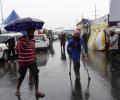
Farmer leader Abhimanyu Kohar, who is a member of Sankyukt Kisan Morcha, said on Sunday that farmers have waterproof tents but they cannot protect them from biting cold and waterlogging.
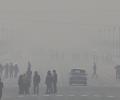
The minimum temperatures are very likely to fall by 2-5 degrees Celsius over most parts of East India, Central India over the next two-three days, while the spell of intense cold can extend beyond that in the Northwest part of the country.

Dense to very dense fog engulfed the Indo-Gangetic plains, including Delhi, for the second morning on the trot on Tuesday, lowering visibility to 50 metres in the city and affecting road traffic and train movement.

The mercury breached the 46-degree Celsius mark in several places such as Allahabad (46.8 degrees Celsius) and Jhansi (46.2 degrees Celsius) in Uttar Pradesh; Sports Complex (46.4 degrees Celsius) in Delhi; Ganganagar (46.4 degrees Celsius) in Rajasthan; Nowgong (46.2 degrees Celsius) in Madhya Pradesh; and Maharashtra's Chandrapur (46.4 degrees Celsius).

Several parts of north and west India reeled under scorching heat wave with the temperature touching 50 degree Celsius in Rajasthan's Churu district on Tuesday, even as the meteorological department predicted very heavy rainfall in Assam and Meghalaya till May 28.

The India Meteorological Department, which had issued a red colour-coded alert for north India for May 25-26 when the prevailing heatwave conditions are expected to peak, said dust and thunderstorms are likely to bring some relief on May 29-30.

According to the India Meteorological Department (IMD), the Ayanagar weather station recorded 99.2 mm rainfall, the maximum in the city, during the 24-hour period ending at 8.30 am on Thursday.

Traffic in national capital Delhi and adjoining Gurugram went haywire on Wednesday after heavy rains resulted in waterlogging in many parts of the city.

The driver and the conductor of a bus that got stuck at the Minto Bridge underpass due to waterlogging were rescued by fire department personnel, officials said.

The national capital battled weather conditions in the "red category" as the maximum temperature recorded at the Palam observatory was 46.1C,

Experts said unfavourable meteorological conditions -- calm winds and low temperatures -- and smoke from farm fires in neighbouring states led to a dense layer of haze as the air quality index entered the "severe" zone.

Heavy rain alert continued in Himachal Pradesh as the monsoon intensified in the various districts of the state.

In Uttar Pradesh, two persons were killed since Tuesday in the floods which have affected around 8.7 lakh people in 987 villages of 28 districts in the state.

A tormenting heatwave swept through North India on Sunday with the mercury crossing 49 degrees Celsius in pockets of Delhi, while the weather office forecast some relief Monday onwards.

The weatherman has predicted rainfall throughout the day with the mercury settling at 19C.
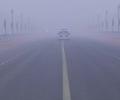
Due to heavy fog on Saturday morning, four flights have been diverted from Delhi airport.

Heavy rains accompanied by strong winds damaged many cars, brought traffic to a grinding halt, left trees uprooted and led to power outages in various parts of the capital on Monday.

At least 33 people have been killed in flash floods in Bihar till Tuesday evening and 25.71 lakh people are affected in 16 districts of the state.

Incessant rains over the past two days in eastern Rajasthan have led to a flood-like situation in the region and severed road connectivity to many areas.

There was no relief for the national capital, with the mercury crossing the 44C mark in some parts of the city.
 © 2026 Rediff.com - Advertise with us - Disclaimer - Privacy Policy - Sitemap - Feedback - About us - Terms of use - Grievances